Mortgage Pre-Approval vs Pre-Qualification
This guide on Mortgage Lenders for Bad Credit covers the difference between mortgage pre-approval vs pre-qualification. What is the difference between mortgage pre-approval vs pre-qualification? Bill Burg, a senior mortgage loan originator at NEXA Lending and an associate contributing editor at GCA Forums says the following:
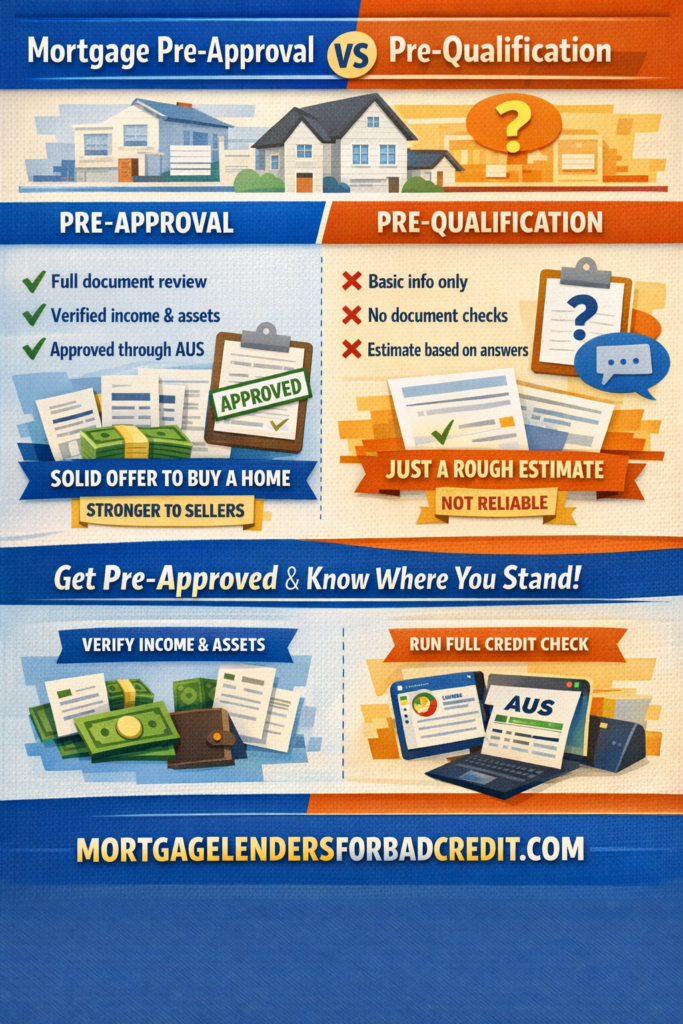
There is a huge difference between a solid pre-approval vs pre-qualification. When a loan officer interviews the mortgage loan applicant, the loan officer will take notes and determine whether the borrower is pre-qualified. This is what you call a pre-qualification.
The loan officer normally does not have the documents in front of him. All the answers given to the loan officer from the borrower is assumed can be verified. Once the interview is over, the loan officer will either tell the borrower they qualify for a mortgage loan contingent upon verification. The mortgage loan originator will request documentation such as 30 days paycheck stubs, two years W2s, 60 days bank statements, and other documents.
Documents Required To Get Pre-Approved For a Mortgage
Once the mortgage loan originator has the supporting documents, the MLO will run a tri-merger credit report and run the file throught the automated underwriting system. If the AUS comes back with an approve/eligible, the borrower is pre-approved. If it comes back with an refer but eligible, the borrowers could get approved if they meet manual underwriting guidelines. If the AUS renders a refer and ineligible, the borrower is not approved.
Prior to using a pre-approval letter, the loan officer needs to carefully review supporting documents of the loan applicant and/or co-applicants such as the following:
- 30 days of paycheck stubs
- Two years of W-2s and/or federal income tax returns
- Tri-merger credit report
- Assets such as 60 days of bank statements, IRA, savings accounts, investment accounts, and other documents to determine down payment and closing costs
- Go over the loan applicant’s liability information
- A pre-approval letter will then be issued after the loan officer has thoroughly reviewed and has submitted the file through the automated underwriting system and got an approve/eligible
In the the following paragraphs, we will discuss and cover the difference between a mortgage pre-approval vs pre-qualification.
Get a real pre-approval (not a guess).
Ready to shop with confidence? Get a solid pre-approval based on verified income, assets, and a tri-merge credit report—so sellers take your offer seriously.
What Is The Major Difference Between A Mortgage Pre-Approval vs Pre-Qualification?
There is a big Difference Between Mortgage Pre-Approval vs Pre-Qualification: Every loan originator have their own way of determining pre-approval vs pre-qualification. Bill Burg, a dually licensed real estate agent and MLO at NEXA Lending says the following:
A pre-approval means the loan originator has interviewed and thoroughly reviewed the necessary documents of the borrower and co-borrowers(if applicable), has run a tri-merger credit report, and the AUS has rendered an approve/eligible findings..
A pre-qualification is basically to see whether home buyers are qualified to proceed to the next level, which is a pre-approval. Most home seller’s realtors do not care about a pre-qualification letter. This because a pre-qualification is, is an interview between the loan officer and home buyer. Loan officers ask basic questions, collect docs, run credit, and runs Automated Underwriting System, and issues a pre-qualification letter. In this article, we will cover and discuss the Difference Between Mortgage Pre-Approval vs Pre-Qualification.
The Pre-Approval Mortgage Process
Borrower answers questions, completes the loan application, forwards mortgage docs, and loan officer determines that the borrower is pre-qualified for a mortgage loan. Most times loan officers issue pre-approvals without verifying the documents from the mortgage loan applicant. This is when trouble can start.
Loan officers should never issue pre-approvals without fully making sure the loan will close. On TBD underwriting approvals, mortgage underwriters issue pre-approval letters after the mortgage file have been fully underwritten and all docs verified.
How Does One Get Pre-Qualified For Mortgage
Many lenders will have a cap of debt to income ratios of no higher than 45%.
The Pre-Qualification Mortgage Process
- W-2 employee or 1099 wage earner?
- What were wages and/or income for the past 2 years?
- How long on the job?
- Any gaps in employment?
Full-time status on the current job?
Can Other Income Be Used As Qualified Income?
Any other income, such as the following can be used as qualified income if the borrower has a two-year history of earning such income: The following income can be used as qualified income with 2 years of seasoning:
- part-time income
- overtime income
- bonus income
- child support income
- alimony income
- royalty income
- social security income
- pension income
- other income
- If so, was that income for the past two years?
- Is that income likely to continue for the next 3 years?
Does the borrower claim unreimbursed business expenses on tax returns and if so how much?
Credit Score Guidelines
Do borrowers have any idea of what their credit scores are?
- If so what is the middle credit score?
- Does the borrower have prior foreclosure, bankruptcy, deed in lieu of foreclosure, short sale?
- If so how long has it been?
- Do borrowers have any open collections, medical collections, judgments, tax liens, child support payments, alimony payments?
- If so are borrowers timely on them?
- Have borrowers been timely on all of the payments for at least the last 6 months, preferably for the past 12 months?
Do borrowers currently rent or live with family or own a home?
Bank Statements Required
If the borrower has been renting, can the borrower provide the past 12 months’ canceled checks and/or bank statements that have been payable to the landlord?
- How much does the borrower have in the bank account?
- Have borrowers bounced checks and/or overdrafts in the past 12 months?
- Do borrowers have enough money for the down payment?
- If not, is the borrower planning on getting a gift from a family member and/or relative?
- If so, is the donor of the gift funds willing to provide you 30 days bank statements showing the down payment has been seasoned for at least 30 days and sign a gift letter?
Pre-Approval Letter
A pre-qualification will turn into a pre-approval once borrowers provide their loan officer all of the MORTGAGE DOCUMENTS NEEDED which confirms mortgage pre-qualification. A pre-approval letter provides strength and confirms mortgage underwriter has fully underwritten and signed off on the mortgage file.
The mortgage underwriter has reviewed the following and verified all documents:
- has qualified the mortgage loan borrower, has reviewed the mortgage application, has run credit, reviewed the borrower’s income
- W-2s, 1099’s, and tax returns reviewed
- has an approve eligible per DU FINDING and/or LP FINDINGS
- has offered the borrower their blessing to enter into a real estate contract
Mortgage Pre-Approval vs Pre-Qualification: Pre-Approval vs Loan Commitments
The pre-approval is the same as a loan commitment and/or conditional loan approval: The conditional mortgage loan approval will turn into a CLEAR TO CLOSE once the borrower has met all conditions such as the following:
- appraisal
- other conditions just as homeowner insurance quotes
- updated verification of employment
- updated proof of funds to close
- other conditions requested by the mortgage underwriter
Difference Between Mortgage Pre-Approval vs Pre-Qualification: Strength Of Pre-Approval
Difference Between Mortgage Pre-Approval Vs Pre-Qualification is pre-approval letter offers strength and the entry to view homes that are listed on the market. All seller’s real estate agents will not accept a real estate purchase offer without a home buyer without a pre-approval letter. Pre-qualification letters will not be accepted by most real estate agents and are pretty much worthless. A pre-approval letter offers the following:
- All TBD property pre-approvals at Gustan Cho Associates Mortgage Group have been fully underwritten and signed off by our mortgage underwriters.
- All our TBD underwriting pre-approvals are loan commitments.
- A pre-approval letter offers how much borrowers will qualify for at what interest rate.
- The type of mortgage loan programs such as an FHA loan, Conventional Loan, VA loan, USDA loan, or Jumbo Loan will be stated on the TBD underwriting pre-approvals signed off by our mortgage underwriters.
- A pre-approval will give a borrower what the principal, interest, taxes, and insurance will be; total monthly housing payment.
- A pre-approval letter will show the home seller and selling real estate agent that the home buyer is a qualified home buyer with a solid loan commitment.
Homebuyers should start the mortgage process as soon as possible so the mortgage lender can start working on a solid pre-approval.
See what you qualify for—even with low scores or high DTI.
Not sure if you’re only “pre-qualified” or truly “pre-approved”? Let our team review your docs, run AUS, and map out AUS vs. manual underwriting options if needed.